A new round of US election polls have shifted momentum behind Democratic nominee Hillary Clinton in the three-month dash to November.
Seven national polls conducted after the close of the Democratic convention last week showed the former secretary of state receiving an average increase of nearly 7% compared with her pre-convention support.
Mrs Clinton's favourability ratings have also improved, rising to an average of four points to 41% in recent polls.
Though a larger share finds her unfavourable at an average of 53%, it is still four point less than it was before the convention.
But do the recent batch of surveys paint an accurate picture of what will happen when voters head to the polls in November?
Not quite, according to experts and pollsters.
While Mrs Clinton has gained a comfortable lead over Mr Trump, it will take more than polling to determine who will end up in the Oval Office.
With hundreds of surveys tracking the election, US polls tend to be good at gauging American opinion, according Clifford Young, the president of US Public Affairs for Ipsos polling.
"We have the luxury of large numbers," Mr Young said. "That makes it better and easier for prediction."
However, all of these polls use different methodologies to survey Americans and one of the biggest challenges is determining who actually will cast a ballot in November.
"Polling is very difficult these days," said Brendan Nyhan, an assistant professor of government at Dartmouth College.
"It's hard to get a representative sample of Americans to take a survey online or by phone, and even if you do get a good sample, it's difficult to tell who is actually going to turn out to vote."
Research has also shown polls tend to be the least accurate the further they are from Election Day.
During the early stages of the primary election, parties have yet to select their nominee while voters may not necessarily be paying attention to candidates or the issues, Mr Nyhan said.
For example, polls conducted in January 2003 showed former President George W Bush ahead of Democratic Senator John Kerry by 8% and 17%.
However, Mr Bush finished just 2.5% ahead of Mr Kerry in the popular vote, the slimmest margin of a re-elected president since Woodrow Wilson in 1916, according to Mr Nyhan.
When do US presidential election polls become most predictive?
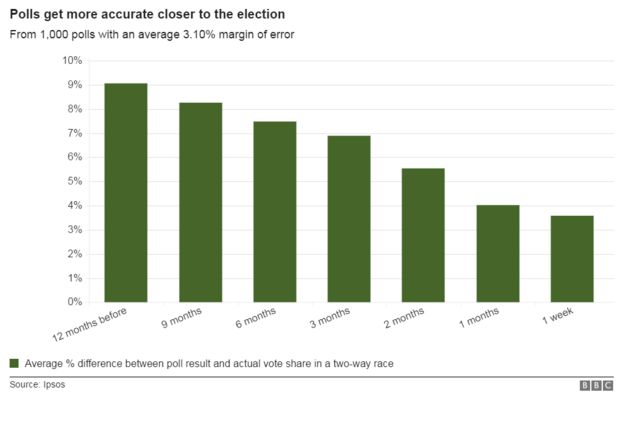
Accuracy improves in the weeks leading up to the election, when people are more likely to have made up their mind, research has shown.
However, surveys released a couple of weeks after the Republican and Democratic conventions, which took place back-to-back last month, is when numbers start to become reliable, according to experts.
Party conventions are often the starting point for wider public interest in campaigns, when party officials have an opportunity to rally behind their nominee and raise awareness on campaign issues.
"The conventions help remind people what the state of the country is and which side they're on," Mr Nyhan said.
However, Sam Wang, a neuroscientist and election analyst at Princeton University, warns that only polls that specifically survey people at the beginning and end of either convention can provide an accurate picture.
Though conventions are an important election marker, Mr Wang points out the public image of a candidate can change over the course of a campaign.
Candidates often receives a "bump" or "bounce" in polls in the week following their party's convention.
For instance, candidates who are underperforming before the convention tend to receive larger bumps while candidates who are running ahead of where they are expected to be often receive smaller bumps.
The bumps, Mr Nyhan explained, helps bring the public closer to the expected outcome.
"The bounce itself doesn't necessarily determine the winner but it helps move it in the right direction," Mr Nyhan said.
But convention bounces tend to be short-lived and mainly come from party supporters.
Mr Trump enjoyed a brief post-convention bump before Mrs Clinton regained a solid lead at the end of the Democratic convention.
In fact, sometimes bounces just show how likely people are willing to respond to a survey or say they will support a candidate, but that does not mean they will show up at the polls.
While national polls can measure movement and general opinion, state polls provide a more nuanced glimpse of where voters stand.
"In a nation as ethnically diverse as the US, it's somewhat challenging to survey the whole country," Mr Wang said.
Consider the Electoral College, which assigns each state a number of electors according to its size.
The winning candidate needs to get a majority of 270 of the 538 electors to win the Electoral College vote.
In majority of US states, the winner takes all of that state's electors, which is why state polls play an integral role in election projections.
Particularly in the key battleground states such as Florida, Ohio and Pennsylvania, polls serve as an important bellwether to November's outcome.
President Barack Obama won all three of those states in 2008 and 2012.
What do the latest polls mean for November's outcome?
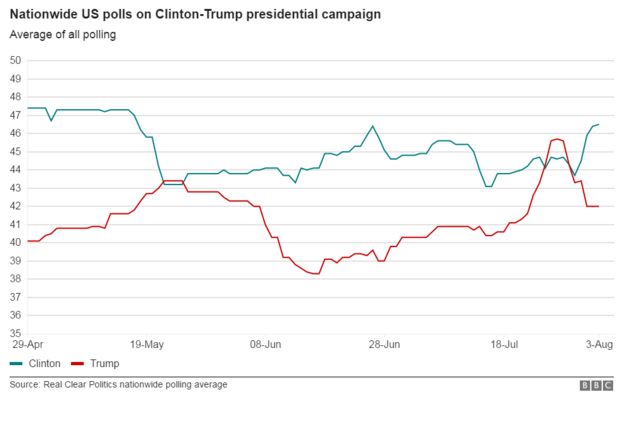
Image captionRecent polls show Mrs Clinton leading Mr Trump by 4.5%
While Mrs Clinton's bounce has given her a comfortable lead over Mr Trump, experts say whether it will stick will not be clear until the next couple of weeks.
However, her rise may be meaningful because there are not many events between now and November that are likely to change people's minds, Mr Nyhan added.
Still, the recent series of polls are more indicative in the short term of relative performance.
Mrs Clinton's bump may suggest she had a better convention performance, Mr Young said.
According to a recent Gallup poll, Americans said they were 45% more likely to vote for Mrs Clinton while 41% said they were less likely to cast their ballot for her after the Democratic convention.
In contrast, Gallup found the 2016 Republican convention marked the first time in history in which more voters said they were less likely to vote for a party's nominee after its convention.
In fact, 51% of those surveyed said they were less likely to vote for Mr Trump compared to 36% who said they were more likely to cast their ballot for him after the Republican convention.
Are this election's polls any different from previous elections?
Image copyrightGETTY IMAGESImage captionThis year's candidate's are deeply unpopular
Though Mr Wang noted this year voter attention is unusually high, the last three elections have shown less movement in polls than in previous campaign years.
"Voter polarisation has gotten a lot stronger, which means voters are less and less likely to consider the other candidate," he said.
In fact, one indication is the size of the convention bounces, which have become notably smaller in recent election history.
According to Gallup, candidates saw an average convention bump of 6.2% from 1964 to 1992 while today they see an average of 3.8%.
However, Mr Young emphasises this year is a disruptive election, with campaigns marked by a stronger protest vote.
This year's forecasts must also take in account just how deeply unpopular Mrs Clinton and Mr Trump are compared with previous elections, which means it ultimately will rely on voter turnout.
"The desire to vote for neither candidate complicates things," Mr Young said. "The protest vote can have potential to really impact the outcome when it comes to the election."
As the 2016 presidential election has demonstrated, anything could happen in the race to the finish line.
Donald Trump spent much of his campaign breaking political norms. Depending on whom you ask, it's either one of his most endearing qualities or the greatest threat his candidacy poses.
Now, however, he's calling into question one of the foundations of US democracy - the legitimacy of its electoral process.
In the fever swamps on the left and the right, plenty of Americans have doubted the integrity of US elections.
They've levelled accusations of voter fraud. Or hacked voting machines. Or polling-place intimidation.
Some of the allegations even contain kernels of truth.
Many US voting electronic machines are woefully unsecure and produce no hard-copy backup. There have been instances of voter impersonation - although they're extremely isolated and usually involve absentee balloting. New Black Panther activity around Pennsylvania polling sites in 2008 inflamed conservatives, although a US Justice Department investigation found no illegal activity.
You don't have to dig too deep into social media or the partisan commentariat to find a thorough rehashing of any of these particular concerns. What you don't hear - at least not until now - is such accusations coming from the top of a presidential ticket.
At a rally on Monday Mr Trump said he was afraid that the November election "is going to be rigged" - backing up his statement by saying it was something he was hearing "more and more".
In a television interview, he repeated the warning.
"November 8th, we'd better be careful, because that election is going to be rigged," he said. "And I hope the Republicans are watching closely, or it's going to be taken away from us."
The "rigging" accusation isn't particularly new for Mr Trump, although he'd previously only levelled it toward the sometimes Byzantine candidate nomination process. It's much easier to question party systems that rely on state-by-state primaries and often poorly managed caucuses, as well as frequently altered delegate allocation procedures.
Mr Trump has said Hillary Clinton benefitted from a rigged Democratic Party apparatus to defeat Vermont Senator Bernie Sanders. (Mrs Clinton received roughly 3.7 million more votes than Mr Sanders, but recently released hacked emails indicate that the Democratic National Committee was manoeuvring to support the former secretary of state behind the scenes during the final months of the primary season).
Mr Trump also accused Republican Party officials of attempting to deny him the nomination, after presidential rival Ted Cruz took advantage of delegate rules to position himself to upset Mr Trump - who had a significant advantage in the popular vote - in a contested convention.
Calling the US presidential nomination system "rigged" can be overheated rhetoric, but that playing field is often tilted toward the establishment. US politics isn't too far from removed a time when nominees were picked by party bosses, while rank-and-file voters had little or no say in the process.
General elections are different. Their rules are set forth in state and federal law, overseen by courts and governed by provisions enshrined in the US Constitution.
"National elections have a clear cut set of rules," writes Josh Marshall of Talking Points Memo. "The only way to rig them is to change the vote numbers."
For Mr Trump to call the fairness of US elections into question - months before Americans head to the polls, no less - is a significant break with the tradition of presidential candidates paying respect to the electoral process, win or lose.
In 2000, after a contentious presidential contest that careened past election day and into an extended recount of the Florida vote and multiple rounds of lawsuits only settled by the US Supreme Court, Democrat Al Gore conceded defeat and called for unity.
"This is America," he said. "Just as we fight hard when the stakes are high, we close ranks and come together when the contest is done."
Eight years later, Republican nominee John McCain did his part to tamp down unrest within his own party following Barack Obama's election. When the audience booed his every mention of his opponent during his concession speech, he rebuked them.
"Please, please," he said to quiet the crowd.
"I urge all Americans who supported me to join me in not just congratulating him," he continued, "but offering our next president our good will and earnest effort to find ways to come together to find the necessary compromises to bridge our differences and help restore our prosperity, defend our security in a dangerous world, and leave our children and grandchildren a stronger, better country than we inherited."
Mr Trump's "rigged" language may simply be a rhetorical flourish from a candidate prone to extemporaneous musings - but it's already making the rounds among his supporters
In a podcast last week, long-time Trump advisor Roger Stone said that if the election results in November don't match opinion polls, the Republican nominee should challenge the validity of the election and warned that the unrest could end in a "bloodbath".
"If there's voter fraud, this election will be illegitimate," he said. "The election of the winner will be illegitimate, we will have a constitutional crisis, widespread civil disobedience, and the government will no longer be the government."
Such upheaval may be painfully familiar to those living in the world's less established democracies. It would be uncharted territory for the United States.
Save for laterThe parents of a Muslim American soldier killed in Iraq said on Sunday Donald Trump was a “black soul” unfit for the White House, after he insulted them and suggested he had made sacrifices for the US comparable to their son’s.
Amid widespread astonishment at the conduct of the Republican presidential nominee, the family of the 27-year-old army captain Humayun Khan, who died in a suicide bombing in 2004, said Trump was morally deficient and incapable of empathy.
“He is totally unfit for the leadership of this beautiful country,” said Khizr Khan, Humayun’s father.
Hillary Clinton, Trump’s opponent in November’s election, spoke later on Sunday at a predominantly African American church in Cleveland Heights, Ohio. Trump, she said, had offered the Khan family “nothing but insults, degrading comments about Muslims, a total misunderstanding of what made our country great”.
Trump’s running mate, Mike Pence, sought to repair some of the damage by releasing a statement on Sunday night.
“Donald Trump and I believe that Captain Humayun Khan is an American hero and his family, like all Gold Star families, should be cherished by every American,” it said.
But it included a swipe at the “disastrous decisions of Barack Obama and Hillary Clinton” that had led to “a once stable Middle East” being overrun by Islamic State.
“This must not stand,” the statement said. “By suspending immigration from countries that have been compromised by terrorism, rebuilding our military, defeating ISIS at its source and projecting strength on the global stage, we will reduce the likelihood that other American families will face the enduring heartbreak of the Khan family.
“Donald Trump will support our military and their families and we will defeat the enemies of our freedom.”
Khan also pleaded with Senator Mitch McConnell and the House speaker, Paul Ryan, the Republican leaders in Congress, to denounce Trump’s comments about his family and his attacks on Muslims. Neither McConnell nor Ryan responded with explicit criticism of Trump’s remarks about the Khans.
In a statement released on Sunday, McConnell said “Captain Khan was an American hero” and said he agreed “with the Kahns [sic] and families across the country” that a ban on Muslim immigration would be “contrary to American values”.
Ryan issued a statement that covered similar sentiments and said Captain Khan’s “sacrifice – and that of Khizr and Ghazala Khan – should always be honored. Period.”
Khan urged Trump’s children to intervene and fix his character after Trump mocked Khan’s wife and appeared to suggest she was blocked from paying tribute to her dead son at last week’s Democratic national convention because of her religion.
His wife, Ghazala, dismissed Trump’s insinuation and reiterated that she had been too upset to talk after seeing a picture of her son displayed on the stage. “What mother could?” she asked in an article written for the Washington Post. “Donald Trump has children whom he loves. Does he really need to wonder why I did not speak?”
She also rejected Trump’s claim that employing people in his property company and overseeing the building of “great structures” amounted to a sacrifice for his country. “Donald Trump said he has made a lot of sacrifices,” she wrote. “He doesn’t know what the word sacrifice means.”
The Khans were as roundly supported as Trump was condemned, after the Republican nominee criticised Ghazala Khan for standing silently beside her husband while he delivered his moving speech about their son and Trump’s attacks on Muslims to the Democratic gathering in Philadelphia on Thursday evening.
“His wife, if you look at his wife, she was standing there,” Trump told ABC’s This Week. “She had nothing to say. She probably … maybe she wasn’t allowed to have anything to say. You tell me. But plenty of people have written that. She was extremely quiet. And it looked like she had nothing to say.”
Khizr Khan told CNN’s State of the Union Trump was “totally incapable of empathy”, adding: “I want his family to counsel him. Teach him some empathy. He will be a better person, but he is a black soul.”
Reiterating his wife’s explanation that she was too overcome by grief to say anything at the event as planned, Khizr Khan expressed disbelief that Trump still “had to take that shot at her”. His wife also has high blood pressure and felt so unsteady she worried she might fall offstage, he said.
“She said, ‘You know my condition – when I see my son’s picture I cannot hold myself together,’” said Khan, becoming tearful. “This country holds such a person in the highest regard, and he has no knowledge, no awareness. That is the height of his ignorance.”
In her article on Sunday, Ghazala Khan wrote: “I cannot walk into a room with pictures of Humayun ... Walking on to the convention stage, with a huge picture of my son behind me, I could hardly control myself.”
Khizr Khan said Trump lacked both the moral compass and sense of empathy necessary for any president. “This candidate is void of both traits that are necessary for the stewardship of this country,” he said.
Trump was sharply criticised by Clinton; Tim Kaine, her running mate; and Bill Clinton, the 42nd US president. Bill Clinton said: “I cannot conceive how you can say that about a Gold Star mother,” referring to the award given by the military to mark a death in combat.
On Sunday at Imani Temple Ministries in Cleveland Heights, Clinton said: “[Khizr Khan] and his wife stood before our country to tell the story of their son, Capt Khan, who lost his life running toward danger to protect his soldiers. Mr Khan paid the ultimate sacrifice in his family, didn’t he?
“And what has he heard from Donald Trump? Nothing but insults, degrading comments about Muslims, a total misunderstanding of what made our country great: religious freedom and religious liberty. It’s enshrined in our constitution, as Mr Khan knows because he’s actually read it.”
Clinton added: “I don’t begrudge anyone of any other faith or of no faith at all, but I do tremble before those who would scapegoat other Americans, who would insult people because of their religion, their ethnicity, their disability. It’s just not how I was raised. It’s not how I was taught in my church.”
Later, on the campaign trail, she told reporters: “It’s hard to imagine anyone who has ever run to be president of the United States saying any of what [Trump has] said. And the accumulation of it all is just beyond my comprehension.”
Trump also faced criticism from Republicans. Ohio governor John Kasich said on Twitter: “There’s only one way to talk about Gold Star parents: with honor and respect. Capt. Khan is a hero. Together, we should pray for his family.”
Khizr Khan said on Sunday that he and his wife had been inundated with support, including from “distinguished Republicans” who “have seen the blackness of [Trump’s] character”.
Ignoring calls from some conservative commentators to cease hostilities with the Khans, Trump again insisted on having the final word. “I was viciously attacked by Mr Khan at the Democratic Convention,” he said on Twitter. “Am I not allowed to respond?”
Trump was also ridiculed for disputing Khan’s comment in his speech that Trump had “sacrificed nothing and no one” while disparaging Muslims including those, like his son, who had died for their country.
“I think I have made a lot of sacrifices,” Trump told ABC. “I’ve worked very, very hard. I’ve created thousands and thousands of jobs, tens of thousands of jobs, built great structures ... I’ve had tremendous success.”
Asked whether he was seriously stating that this amounted to sacrifice, Trump replied: “Oh, sure. I think they’re sacrifices.”
Trump, who avoided the draft for the Vietnam war with a medical exemption for an apparent bone spur in a foot – he has been unable to remember which one – once said that avoiding sexually transmitted diseases had been his “personal Vietnam”.
After Trump’s remarks were first published in advance of their broadcast on Sunday, the candidate issued a statement declaring: “While I feel deeply for the loss of his son, Mr Khan who has never met me, has no right to stand in front of millions of people and claim I have never read the constitution, (which is false) and say many other inaccurate things.”
The dispute over the memory of Humayun Khan was also picked up by the Islamic State terrorist group. The group’s online magazine featured a picture of Khan’s tombstone in Arlington national cemetery in Virginia with the caption: “Beware of Dying as an apostate.”
The first two opinion polls taken after the end of last week’s Democratic convention indicated that Hillary Clinton had received a “bounce” in her ratings and had retaken a lead against Trump. Her national support stands at 44.5% against 43.4% for Trump, according to an average of polls by RealClearPolitics.
Late on Sunday, after McConnell and Ryan had failed to rebuke Trump over his attacks on the Khan family, Senate Democratic leader Harry Reid released a statement of his own.
“This shouldn’t be hard,” he said. “Donald Trump is a sexist and racist man who insults Gold Star parents, stokes fear of Muslims and sows hatred of Latinos. He should not be president and Republican leaders have a moral responsibility to say so.”